Protests took place in Tel Aviv, Jerusalem, Haifa, and Beersheba, as a survey found broad but uneven support among Jewish Israelis for Operation Roaring Lion.
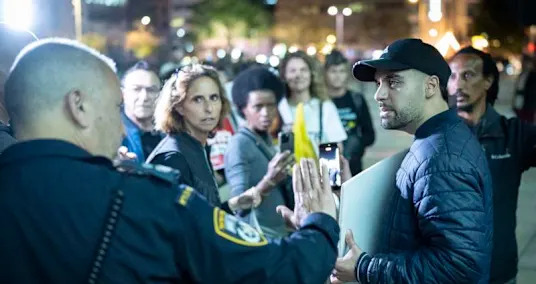
Israel Police arrested 21 anti-war protesters Saturday night as demonstrations against the conflict with Iran expanded in multiple cities despite restrictions on public gatherings.
Protests took place in Tel Aviv, Jerusalem, Haifa, and Beersheba, with hundreds of participants reported in Tel Aviv and Jerusalem and about 100 in Haifa, marking the largest turnout since weekly demonstrations began. Authorities said 13 people were arrested in Tel Aviv and eight in Haifa.
Police said the gatherings were not approved under Home Front Command regulations that ban events with more than 50 people. Officials said the increase in turnout followed calls by groups opposing the government to protest despite the restrictions.
“During a situation assessment that took place at the scene with a Home Front Command representative… it was clarified that there was a real risk to human life and accordingly, Yarkon [precinct] police commander Tzachi Sharabi ordered the gathering to be dispersed,” police said.
Hadash-Ta’al chairman Ayman Odeh, an Arab lawmaker involved in the protests, criticized the police response, calling officers fascists “in the service of the government” and saying they were afraid of “the heroic citizens who went out, despite everything, to make their voice heard.”

Survey shows broad, uneven support for war
The demonstrations come as a March 2026 survey by the Israel Democracy Institute found broad but uneven support among Jewish Israelis for Operation Roaring Lion. Support was strongest on the Right at 87% and about half on the Left.
The survey also found that Jewish and Arab respondents largely agreed that Iran’s resilience has been stronger than expected. Most Jewish respondents said Israeli society could sustain the campaign for up to one month, while 28% said as long as needed. Arab respondents were less optimistic about how long the public could endure the conflict.
A majority of Jewish respondents said Prime Minister Benjamin Netanyahu’s decision was driven by security considerations, while most Arab respondents viewed it as political.
latest_posts
- 1
 UK forecast to face weaker growth and higher inflation from Iran war
 - 2Watch interstellar comet 3I/ATLAS speed away from the sun in free telescope livestream on Nov. 16
- 3Sound Maturing: Wellbeing Tips for Each Life Stage
- 4What to know as New York City nurses strike for a 3rd day
- 5Iran war pushes Germany's deficit to 4.2% as growth outlook is cut by 50%




- Avoid Large Crowds In Bali & Swim At This Peaceful Waterfall With A Gorgeous, Natural Pool
- The Best 10 Innovation Advancements of the Year
- Fact Check: Some Bridge Photos Circulating Do NOT Show The Hongqi Bridge That Collapsed In Southwest China Nov. 11, 2025
- In these U.S. groups, deaths now exceed births. What’s happening?
- UN chief calls on Yemen's Houthi rebels to free all UN detainees
- Twelve injured near Beit Shemesh, reports of shrapnel impact in Eilat as Iran targets Israel
- The Main 10 Natural life Protection Associations
- James Webb Space Telescope watches 'Jekyll and Hyde' galaxy shapeshift into a cosmic monster
- Merz: 80% of Syrians in Germany should return in three years